An author recently contacted me via LinkedIn to ask for help with the book he and a colleague were struggling with. So we had a Zoom chat.
I’ll call them the writing team. They had been commissioned by a major UK publisher, and so had a reasonable brief, but, I was told, they felt they’d come up with a series of decent chapters, but nothing hung together. My diagnosis: there was no coherent story arc.
People often think of story arcs as related to film and TV, and to novels, but the idea is not so limited. Nonfiction needs a story arc too, if the reader is to follow your argument and read through to the end. Facts alone aren’t enough. Interpretation alone isn’t enough – it all needs to gel together as a cogent whole.
Social sciences journal articles have a beginning, a middle and an end: the time-honoured story arc is introduction, literature review, method, results and conclusion. You see the same in theses.
With books, you need the same thing – a beginning, a middle and an end – though not necessarily the same pattern of headings or chapters. You need to plan how you’re going to guide your reader through the set-up, your new information or interpretation and what falls out of that.
Mapping your book
My advice is to think back to when you used to plan your essays – I do hope your teachers got you to do this, especially come exam time!
Take a sheet of paper, a new Word document or whatever you work with. Divide it into four columns, to start with. It’ll look like this:
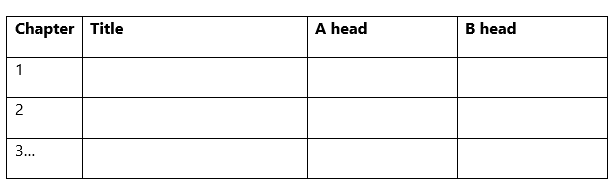
© Sue Littleford 2022
Think about what you need to write about. What’s the logical flow to convey your message? How does it break down into chapter-sized chunks?
For quite a while, this map will be fairly fluid. You’ll think of extra bits, decide something’s not so important, decide one topic is a huuuuuuge chapter, so maybe you want to find a way to break it into two or more. Or maybe something is a bit short to justify a chapter to itself. It’s good to have reasonably consistently sized chapters, but it’s not absolutely essential. But do try to give it a go!
You’ll also start to see whether chapters are your primary chunks, or whether the chapters ought to be grouped into parts with a common theme.
I once had an author send me the first chunk of his book to copyedit. I copyedited it. It was good, but far from finished. I asked why he wanted it to be edited now, incomplete (that’s not normally something I’d agree to do). Turns out he was stuck. A year later, I got the same chunk back, but with a different opening, and the author had plugged away at it to the end. Two years later, I got the entire novel again, which now started with the scene that the second version had ended with, and it was transformed from OK into fantastic.
In my salaried days, we were taught the importance of planning. There was a story I no longer remember much detail about (if you know more, pop something in the comments!) but in essence, it was this.
Two teams, in different countries, were tasked with building a high-tech warehouse. The first country held some planning meetings, decided what to build, then broke ground and got going. They were halfway through the build when country two was still holding planning meetings, working everything out in detail. Country one was well advanced with the build when country two finally broke ground – surely, country one was going to be finished months, if not a year, earlier than country two.
I’m sure you can guess – country two finished first. They had worked out everything in detail, and done all their snagging work when the build was still theoretical and it was cheap and easy to change decisions. Country one had rushed into action, and then hit snag after snag after snag, blowing a hole in the planned delivery date and a bigger one in the budget. Country two came in on time and on budget. Sure, they’d had a few snags – but they’d been small and easily managed, and contingency plans had already been made.
Think of it as an up-to-date fable about the tortoise and the hare.
This is you, when you plan your book – don’t rush into writing. Capture your ideas when they’re at headline level, and move them around, combine them or fragment them until you’re satisfied the list of chapters works.

Now, I want you to pause. This is pretty much where the writing team had got, and then they started writing. Some way in, they found themselves with a handful of chapters, rather than a book.
Mapping your reader
Who are you writing for? Who’s your reader? What do you want them to get from your book? A mass of information? An understanding of your research? To follow an argument in favour of a particular policy, or against it? To receive your reinterpretation of previously established ‘fact’? Why are you writing this book?
I advised the writing team to work out their avatar in some detail, and as they wrote, ask why their reader needed to read this information, this idea, this bit of discussion…
Think about what the reader needs to read, not necessarily what you want to write.
Sue Littleford
The writing team’s book dealt with using new tech responsibly. They needed to be persuasive – but who were they trying to persuade? By figuring out your ideal reader, you can keep that ideal – an avatar – in front of mind as you write. One of the writing team said he was going to write a short description of his ideal reader and stick this avatar at the edge of his screen, so it was in front of his eyes, too. Excellent decision!
When you think this way, you can decide what has to go in, what can be omitted, and your words will start to line up in the right order, within the chapter, and across the book.
Mapping more of the book…
There are still two unused columns in your map of the book. We’ll turn to those now.
One problem I frequently see is authors losing track of their headings. Everything becomes a subheading of what went before it, instead of a new main heading in the chapter. It’s an absolute giveaway that the author hasn’t spent enough time planning but has dived right in.
A chapter’s main headings are called ‘A heads’, very often. Subheadings to the A heads are… yep, B heads, subheadings to those are C heads, and so on. Headings are great as they help your reader navigate – you’re signposting what you’re writing about. However: more than four levels of headings is unrewarding to the reader – it suggests you’ve not chunked up the chapter properly. So let’s go back to our example bookmap.

This time you’re organising your thoughts, chapter by chapter, repeating the same process about logical flow, with your reader’s needs front and centre. How you organise your material depends enormously on your field, the norms of that field, whether you’re following the norms or heading off on a new path, who you’re writing for (are you writing a school textbook, undergrad primer, scholarly exposition? Or are you writing for the general public? Or someone else, perhaps a government body?) so keep looking back at the avatar of your reader.
If you find you need to break down the A heads into subsections, repeat this process, lining up each bunch of B heads with their A head. If you find you’re going much below a C head, take a step back and think this through carefully. How easy will readers find it to follow your structure? What will your avatar of an ideal reader make of it?
Get this part right, and you’ll find the writing so much easier – and faster, as you won’t keep having to double back and move things around. You know where you’re headed, your material is organised logically – and if you have good reason to take things in a different order than pure logic might suggest, then you know in what sequence to reveal your main ideas.
For example, a history book can be chronological, straight through, or by theme. If you’re going by theme, and will keep going back over the same time span from different angles, having a clear, well-considered bookmap will keep you on point, so that your reader can follow your story arc, your writing will be interesting, and far less confusing than if you just pile in without taking the time for a decent think.
Books are curated collections of ideas – at least the good ones are. Just writing down everything you know on your topic, to show that you know it, can be injurious to your book’s health. You need to be telling a story, albeit a factual one.
Readers love a good story.

I enjoyed your comments which were very constructive. Hilary Scott Author of One Day At A Time.
That’s kind, Hilary. I hope you found the article useful.
Sue
Pingback: CIEP conference 2023: Language Matters | Apt Words
Pingback: 6 tips for writing your first scholarly book | Apt Words